

Introduction
You already know a lab-grown diamond is a real diamond grown in a controlled environment rather than mined from the earth if you're catching up, our article, What is a Lab Diamond?, covers that foundation. But how, exactly, does a diamond get grown in a lab? What does that process actually involve, and how long does it take?
This article walks through the science behind it step by step, in plain language so you understand exactly what happens between "raw materials" and "finished diamond." No chemistry degree required.
Table of Contents
- The Starting Point: The Diamond Seed
- The Two Methods: HPHT and CVD
- How HPHT Diamond Growth Works
- How CVD Diamond Growth Works
- How Long Does It Take to Grow a Diamond?
- From Rough Crystal to Finished Gemstone
- How Lab Diamonds Are Tested and Certified
- Which Method Produces "Better" Diamonds?
- Common Misconceptions About the Growing Process
- Frequently Asked Questions
- Summary
1. The Starting Point: The Diamond Seed
Every lab-grown diamond begins with the same basic ingredient: a small diamond seed, typically a thin slice cut from an existing diamond. This seed acts as the foundation that new carbon atoms will bond to, layer by layer, as the crystal grows.
Without a seed, there's no structure for the new diamond to form around it's the essential starting point for both major growing methods.
Quick Fact: The seed itself is a real diamond, meaning even the "starting material" for a lab-grown diamond is genuine diamond, not a synthetic substitute.
2. The Two Methods: HPHT and CVD
There are two established scientific methods used to grow gem-quality diamonds: High Pressure High Temperature (HPHT) and Chemical Vapor Deposition (CVD). Both produce genuine diamonds the difference lies in the environment and mechanism used to build the crystal.
|
Method |
Core Principle |
Environment |
|
HPHT |
Recreates natural underground pressure and heat |
Mechanical press |
|
CVD |
Builds the crystal layer by layer from gas |
Vacuum chamber |
(For the full technical breakdown of how these two methods compare, see our dedicated article, HPHT vs CVD Explained.)
3. How HPHT Diamond Growth Works

HPHT was the original method used to grow synthetic diamonds, dating back to the 1950s. Here's how it works:
- A diamond seed is placed inside a growth chamber alongside a carbon source and a metal catalyst.
- The chamber is subjected to extreme pressure over 1.5 million pounds per square inch and temperatures around 1,400–1,600°C.
- Under these conditions, the carbon source dissolves and slowly crystallizes onto the seed, gradually building up a larger diamond.
- After several weeks, the rough diamond crystal is removed and cooled.
This process closely mimics the natural conditions found deep within the earth's mantle, just compressed into a matter of weeks instead of billions of years.
Did You Know? HPHT is also used as a post-growth treatment for some diamonds including certain natural diamonds to improve color. This is a separate application from HPHT growth, and reputable sellers always disclose when a treatment like this has been used.
4. How CVD Diamond Growth Works
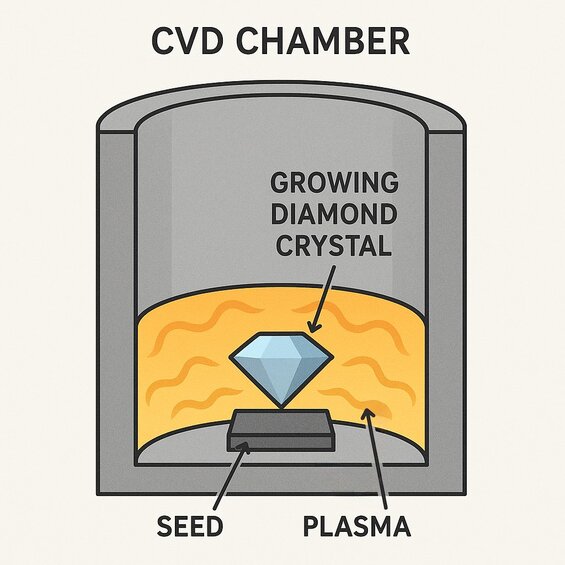
CVD is currently the dominant method for producing colorless, jewelry-grade lab diamonds. Here's the process:
- A diamond seed is placed inside a vacuum chamber.
- The chamber is filled with a carbon-rich gas, typically methane, combined with hydrogen.
- The gas is heated to extremely high temperatures using microwave energy, breaking the molecular bonds and freeing individual carbon atoms.
- These carbon atoms settle onto the seed and bond, one atomic layer at a time, gradually building the crystal upward.
- Over several weeks, this layer-by-layer process forms a complete rough diamond.
Expert Tip: Because CVD builds the crystal gradually and in a highly controlled atmosphere, it tends to produce diamonds with very few inclusions, which is part of why it has become the preferred method for high-clarity, colorless lab diamonds.
5. How Long Does It Take to Grow a Diamond?
Growing time varies based on the size and quality being targeted, but as a general guide:
|
Diamond Size |
Approximate Growing Time |
|
Small stones (under 1 carat) |
2–4 weeks |
|
Mid-size stones (1–2 carats) |
4–6 weeks |
|
Larger stones (2+ carats) |
6–10+ weeks |
This is dramatically faster than the geological timeline of a natural diamond, which takes between one and three billion years to form but it's still a genuinely gradual, carefully monitored process, not an instant manufacturing step.
6. From Rough Crystal to Finished Gemstone
Once a rough lab-grown diamond reaches its target size, it goes through the exact same finishing process as a natural diamond rough:
- Planning — Experts analyze the rough crystal to determine how to cut it for maximum brilliance and minimal waste.
- Cutting — The rough stone is shaped into its target form (round, oval, cushion, etc.).
- Faceting — Precise facets are cut and polished into the stone to control how light enters and reflects.
- Polishing — The surface is finished to a high-gloss shine.
- Grading — The finished diamond is sent to an independent lab (most commonly IGI) for certification.
At no point in this finishing stage does a stone's lab-grown or natural origin change how it's cut or polished the craftsmanship required is identical either way.
7. How Lab Diamonds Are Tested and Certified
Because lab-grown and natural diamonds are chemically and physically identical, standard jewelers' tools cannot distinguish between them. Certification labs use specialized equipment including spectroscopy tools that detect subtle growth-related characteristics invisible to the naked eye to determine a stone's origin with certainty.
This is why every reputable lab-grown diamond should come with an independent certificate clearly disclosing its lab-grown origin alongside its color, clarity, cut, and carat weight. (Our Lab Diamond Certification Guide and IGI vs GIA comparison explain exactly what to look for on these reports.)
8. Which Method Produces "Better" Diamonds?
Neither HPHT nor CVD is inherently superior both are capable of producing exceptional, gem-quality diamonds. The growing method influences certain characteristics (for example, the types of inclusions that may appear), but the diamond's actual quality is determined by its individual cut, color, and clarity grades not by which process grew it.
Common Myth: "CVD diamonds are always better than HPHT diamonds." This isn't accurate quality comes down to the specific stone's grading, not its growth method. (Our Lab Diamond Myths article addresses this misconception, along with several others, in detail.)
9. Common Misconceptions About the Growing Process
Myth: "Lab diamonds are grown overnight." False. Even the fastest-growing stones take a minimum of several weeks, with larger stones taking considerably longer.
Myth: "The growing process makes lab diamonds structurally different from natural diamonds." False. Both processes produce the same crystal structure pure carbon arranged identically to natural diamond.
Myth: "You can tell which method grew a diamond just by looking at it." False. Determining growth method (or origin at all) requires specialized lab equipment, not visual inspection.
10. Frequently Asked Questions
1. How are lab-grown diamonds made? Through one of two processes HPHT (High Pressure High Temperature) or CVD (Chemical Vapor Deposition) both of which grow a diamond seed into a full crystal over several weeks.
2. What is HPHT diamond growth? A process that recreates the extreme heat and pressure diamonds experience underground, using a mechanical press to grow a diamond seed.
3. What is CVD diamond growth? A process that grows a diamond seed inside a vacuum chamber, using heated carbon-rich gas to build the crystal layer by layer.
4. How long does it take to grow a lab diamond? Typically 2 to 10+ weeks, depending on the target size and quality.
5. Is HPHT or CVD better? Neither is inherently better a diamond's quality depends on its individual cut, color, and clarity grade, not its growth method.
6. What is a diamond seed? A small slice of existing diamond used as the foundation for new carbon atoms to bond to during the growing process.
7. Do lab diamonds require cutting and polishing like natural diamonds? Yes. Once the rough crystal is grown, it goes through the same cutting, faceting, and polishing process used on natural diamond rough.
8. Can jewelers tell if a diamond is lab-grown just by looking at it? No. Specialized lab equipment is required to determine a diamond's origin visual inspection alone cannot do this.
9. Is the CVD process the same as 3D printing a diamond? No. CVD grows a genuine crystal structure atom by atom through a chemical bonding process it is not an additive manufacturing or printing technique.
10. Does the growing method affect a diamond's durability? No. Both HPHT and CVD diamonds share the same hardness and durability as natural diamonds.
11. Are all colorless lab diamonds grown using CVD? Most modern colorless, jewelry-grade lab diamonds use CVD, though HPHT is also used, particularly for certain fancy-color stones.
12. How is a rough lab diamond turned into a finished gemstone? It's planned, cut, faceted, and polished by skilled diamond cutters using the same techniques applied to natural diamond rough.
11. Summary
Growing a diamond in a lab is a genuinely scientific, carefully monitored process not an instant manufacturing shortcut. Whether grown through HPHT's extreme heat and pressure or CVD's gradual, layer-by-layer gas deposition, the result is the same: a real diamond, identical in composition and structure to one formed underground, just created on a human timeline instead of a geological one.
If you'd like to understand the technical differences between HPHT and CVD in more depth, our dedicated guide, HPHT vs CVD Explained, is the next place to look. Or, for the complete picture from grading to certification to buying advice our Ultimate Lab-Grown Diamond Guide covers everything you need.
Ready to see the results of this process for yourself? Explore Silvora Carats' collection of premium lab-grown diamond engagement rings and fine jewelry every stone independently certified and thoughtfully set for a lifetime of wear.
This article is part of the Silvora Carats Lab-Grown Diamond Knowledge Hub, reviewed for gemological accuracy. It is intended for general educational purposes.